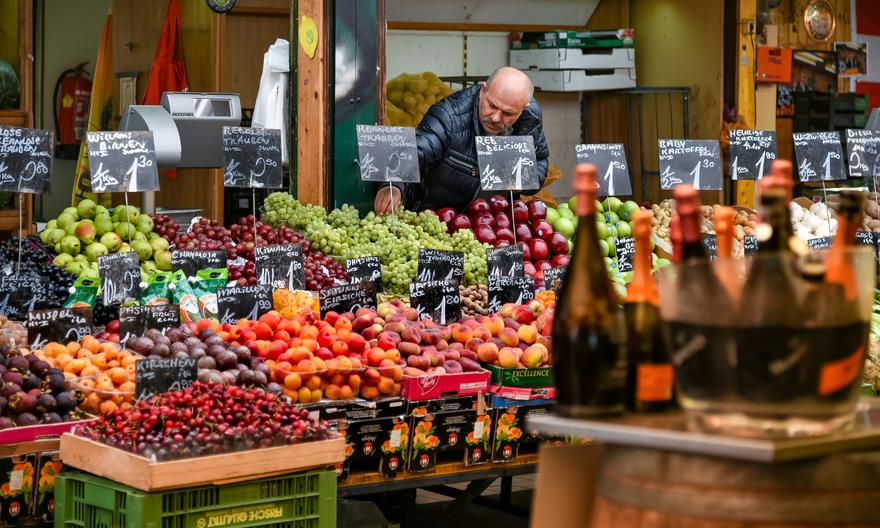
Local food matters for overall health because where our food comes from influences what ultimately reaches our cells. Nutrient quality, freshness, agricultural practices, soil biology, environmental exposures, and even the resilience of our food supply are all part of the picture.
I often recommend growing at least some of your own food—even if it’s just herbs, tomatoes, or a few vegetables in containers. Growing something reconnects us with the biological system behind our food and gives us greater control over how it was produced.
Here’s why I believe this connection is so important:
1. Freshness can preserve nutritional quality
Locally grown food can often be harvested closer to peak ripeness and reach your plate much faster than food traveling through a long supply chain. That matters because some nutrients begin declining after harvest, and varieties bred primarily for shipping durability and shelf life aren't necessarily selected for flavor or nutritional characteristics.
When you buy from a local farmer—or walk into your backyard and pick dinner—you shorten the distance between living plant and human biology.
Freshness isn't the only thing that determines nutritional value, but it is one piece of the nutrient-density puzzle.
2. You can know more about how your food was produced
“Local” doesn't automatically mean organic, regenerative, pesticide-free, or toxin-free. That's an important distinction.
What local food does offer is something our industrial food system often lacks: proximity and transparency.
You can ask the farmer:
What was sprayed on this crop?
How do you manage weeds and pests?
Do you use compost—and where does it come from?
How do you build soil fertility?
How are your animals raised and fed?
Those conversations matter. They allow us to choose producers whose practices reduce unnecessary chemical inputs and support healthier ecosystems.
And when you grow your own, you have even greater control over those decisions.
3. Healthy soil is part of the human-health conversation
We tend to think nutrition begins at the grocery store.
It doesn't.
Nutrition begins in the soil.
Plants depend on soil biology, minerals, water, sunlight, and complex relationships with microorganisms. Regenerative practices that protect soil structure, organic matter, microbial activity, and nutrient cycling create a very different growing environment than repeatedly degraded soil.
That doesn't mean every locally grown carrot is automatically more nutritious than a conventionally grown carrot. Biology is more complicated than that.
But it does mean we need to start asking a bigger question:
What kind of biological system produced the food we're asking our bodies to live on?
Soil health, plant health, animal health, and human health aren't separate conversations. They're interconnected layers of the same ecological system. Regenerative practices are at the core of biological support for these ecosystems
4. Local food often moves us toward real food
One of the greatest benefits of shopping farmers markets, joining a CSA, buying directly from producers, or growing your own food is surprisingly simple:
You tend to eat more actual food.
Vegetables. Fruits. Herbs. Eggs. Meat. Fermented foods. Seasonal foods. Foods that still resemble what they were when they came from the earth.
Those foods provide fiber, micronutrients, phytochemicals, protein, and other compounds that support the gut microbiome, blood-sugar regulation, immune function, cellular metabolism, and normal elimination.
That's a very different biological input from a diet dominated by ultra-processed products engineered primarily for convenience, shelf stability, and palatability.
5. Fewer unnecessary inputs can mean less for the body to manage
Our bodies are constantly processing what comes in.
Food. Water. Air. Medications. Hormones. Metabolic waste. Environmental chemicals. Naturally occurring compounds. Everything we encounter has to be recognized, utilized, transformed, stored, or eliminated in some way.
That's why I talk so much about total body burden.
Detoxification isn't a trendy cleanse. It's normal physiology happening every minute of every day through interconnected systems involving the liver, kidneys, gastrointestinal tract, lungs, skin, lymphatic circulation, and cellular pathways.
Choosing minimally processed food and knowing more about how that food was produced is one way we can reduce unnecessary inputs while supplying the nutrients those systems require to function.
6. Local food creates resilience beyond the individual
This is where “All Health Is Local” becomes much bigger than nutrition.
When we support farmers who care for their soil, we aren't simply buying better tomatoes.
We're helping maintain farmland, agricultural knowledge, regional food production, local economies, relationships between growers and consumers, and access to food produced closer to home.
A resilient human being still depends on a resilient community.
And a resilient community depends, in part, on its ability to feed itself.
That's why I see growing food—even a little of it—as an act of health and resilience. You begin to understand seasonality, soil, weather, insects, failure, abundance, and just how much biology is involved in producing a single meal.
The bottom line
Local food isn't simply a lifestyle preference. It's an opportunity to reconnect human health with the biological systems that sustain it.
It gives us the opportunity to know our farmers, understand our food, reduce unnecessary processing, eat closer to the source, support healthier soil practices, and become less disconnected from the origins of our nourishment.
Your health doesn't begin in a supplement bottle.
It doesn't even begin on your plate.
It begins further upstream—with the soil, water, sunlight, microorganisms, plants, animals, farmers, and communities responsible for producing the food that eventually becomes you.
That is why I say:
🌱 All Health Is Local.
Know your farmer. Know your food. And whenever you can, grow something.









Comments